- 1 Technical notes
- 2 Industrial Applications
- 3 Silo Cyclones Suctions
- 4 Cyclones for dust and sawdust absorption.
- 5 Filter unit with valves and filt
- 6 Water painting booths filters
- 7 Waterfalls Furniture paint.
- 8 Filters Bag filters
- 9 Absorbent scrubbing benches
- 10 Wood air boilers
- 11 Oil Gas Air Boilers
- 12 Carbon block
- 13 Ιndustrial fans
- 14 Centrifugal fans
- 15 High Pressure Centrifugal Absorbers.
- 16 Centrifugal belt-driven extracto
- 17 Double suction hoods.
- 18 Exhausts in an aerobox
- 19 Explosion-proof absorbers
- 20 ELECTRIC MOTORS MOTOR
- 21 INVERTER 220-380 V
- 22 Fan - blades Hood blades
- 23 Rotary valve - Air barriers
- 24 AXIAL FAN INDUSTRIAL VENTILATORS AXIAL FAN
- 25 Αxial fans
- 26 Hoods Fans Fireplace vents
- 27 Ducts and Accessories
- 28 Flexible spiral airways
- 29 Gas and smoke extraction arms
- 30 Ventilation for car workshops.
- 31 Flexible spiral airways
- 32 Filters and prefilters on a roll
- 33 Air cooler Cooling of outdoor sp
- 34 Axial water heaters
- 35 Air conditioning
- 36 Shop equipments (INOX)
- 37 Louvers ventilation openings
- 38 Grille-damper
- 39 Fans
Cyclones.
Cyclones.
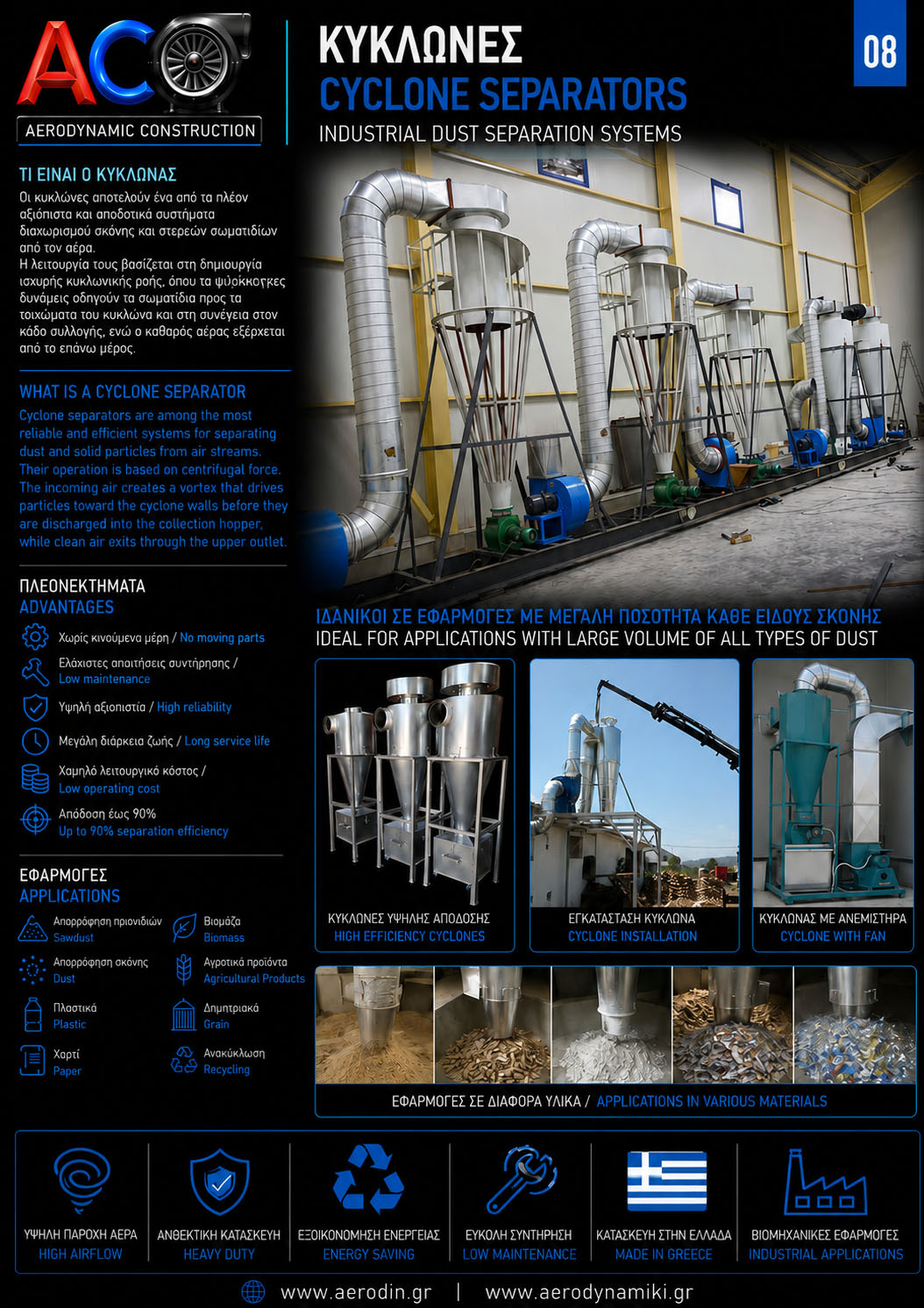
The most common type of dust collector used is the cyclone, where dust and particles together with air enter a cylindrical or conical space tangentially at one or more points and leave through a central opening. It is a structure without moving parts where the gas stream is transported in a confined vortex where centrifugal forces tend to drive the particles to the walls of the cyclone. That is, the particles, due to their inertia, tend to move towards the walls.
Ideal in applications with a large amount of any kind of dust.
Dust absorption
Plastic absorption
Sawdust absorption
Paper absorption
The cyclone will be used as the basis for the description of the vortex. The gas entering the inlet near the top of the cylindrical body creates a vortex or spiral flow descending between the outlet walls of the gas stream and the body of the cyclone. This vortex is called the main vortex and descending from a certain point and then, near the base of the cone, it changes direction but maintains its rotational motion. Thus a second vortex is driven upwards towards the gas outlet.
High-efficiency cyclones can function as final separators with retention of up to 90%.
For Buying Advice, Ideas & Product Support contact at +30 2310 781 422
The most common type of dust collector used is the cyclone, where dust and particles together with air enter a cylindrical or conical space tangentially at one or more points and leave through a central opening. It is a structure without moving parts where the gas stream is transported in a confined vortex where centrifugal forces tend to drive the particles to the walls of the cyclone. That is, the particles, due to their inertia, tend to move towards the walls.
Ideal in applications with a large amount of any kind of dust.
Dust absorption
Plastic absorption
Sawdust absorption
Paper absorption
The cyclone will be used as the basis for the description of the vortex. The gas entering the inlet near the top of the cylindrical body creates a vortex or spiral flow descending between the outlet walls of the gas stream and the body of the cyclone. This vortex is called the main vortex and descending from a certain point and then, near the base of the cone, it changes direction but maintains its rotational motion. Thus a second vortex is driven upwards towards the gas outlet.
High-efficiency cyclones can function as final separators with retention of up to 90%.
For Buying Advice, Ideas & Product Support contact at +30 2310 781 422